 Christmas is a mere seven days away, and even with many tasks already accomplished, there is a hefty 'to do' list yet to tackle. Tomorrow holds the last few gift purchases, wrapping the last few gifts, a Costco shopping trip for ingredients to bake cookies, baking cookies, finish writing and laying out the annual newsletter, printing the newsletter and envelopes, writing messages on each newsletter, stuffing and stamping envelopes, and... . Um, gosh, I guess that's it.
Pffft. Yeah. Piece of cake!
Can't spread it out over the weekend because Sunday is booked. We start bright and early with breakfast at our favorite diner. We want to give our regular waitress a Christmas card -- and have a great omelet. Then I have a pedicure (I know, it's rough). From there, off to Sam and Donna's house to watch the Seahawks beat the Titans. Then, to a Christmas party. It'll be 8:00 pm before we get home.
Phew! The holidays are a crazy time. Speaking of crazy (and I mean that in the best possible way), I'd mentioned in my last post that my Dad is one of Santa's best helpers. He started playing Santa in high school in the 1950s and never stopped. In one of my favorite pictures, Dad is dressed as Santa, and a six-year-old me is sitting in his lap. It was taken in his office, in the basement of the police station. I remember the day. The photographer from the newspaper thought it was so funny that this little girl knew her father was Santa Claus.
He had two suits, but my favorite was the antique velvet one with thick white fur trim. His wig and beard were flawless, save the amber evidence of a skinny pipe he smoked between stops. He carried a leather strap with large jingle bells attached it, and used it to announce his arrival. He wore white cotton gloves and black leather boots.
He visited schools, churches, offices, private family parties. The weeks between Thanksgiving and Christmas were a blur of activity. He occasionally recruited one of us to help. I always loved to play elf. We'd approach someone's home in his station wagon and a hundred feet before arriving, he turn off the engine and lights, shift into neutral, and coast into the driveway. I'd make sure that his supply of tiny candy canes was ample, and then load up his bag with wrapped gifts the family left in a garage or porch. Once inside, I'd help him distribute them to crowds of sleepy and enthralled kids.
He would never take money for his visits. His regular groups and families would have a gift for him. Sometimes, it was fruitcake or a bottle of wine. More often, it was some sort of Santa tchotchke. In more than four decades, he literally accumulated a room full of Santa stuff. I can attest to this. Aside from the obvious fact that I grew up in the house where this collection steadily increased over the years, I also boxed up most of it a couple years ago so that the room could be utilized! I lost track of how many 40-quart storage containers the collection required. It was a lot. A few of his favorite items remain in the house. Of those, my favorite is a miniature aluminum biplane assembled completely of limited edition Santa Claus Coca-Cola cans.
When my father retired from his day job, he decided to embrace the Santa lifestyle 24/7. By this I mean, he grew out his hair and beard, and spent his time woodcarving. Despite a thick head of jet black hair (something many men his age would have paid money to have), he dyed it all white. Well, as white as jet black hair would be allow itself to be dyed. It was more of a super-platinum blonde. The Santa gig went on for a couple years after retirement, until his health prevented him from continuing any longer.
Dad still loves his Santaness and revels in the joy of Christmas. He doesn't need to dye his hair and beard anymore, although it's more of a sodium-heavy salt-and-pepper now. His oldest grandson, Andrew (my nephew), is now in possession of the velvet suit and started the Kringle routine last year at age 18.
This month, I've received a forwarded holiday email from several people that reads as follows:
The Four Phases of Life
1. You believe in Santa Claus
2. You don't believe in Santa Claus
3. You are Santa Claus
4. You look like Santa Claus
I told this to my Dad a couple weeks ago while waiting for our table at a restaurant. He laughed. Then he said, "except one thing... I never stopped believing."
Saturday, December 17, 2005
600 quarts of santa


Thursday, December 15, 2005
an opinion about christmas
I love Christmas. I cherish the traditions and luxuriate in spirit of the day that literally lasts more than a month for me. This is easy for me to say. I was raised a Christian. I am also fortunate that my father is one of Santa's most dedicated helpers ever.
This year, it's been hard to listen to the debate raging over the use of the terms "Merry Christmas" and "Happy Holidays." Are people really fighting about this? Yes, they are, and with every fiber of their being. I found one site with some interesting perspectives on both phrases. I've read countless articles and heard news pieces on NPR about the contention of the day.
Here is my opinion on these phrases.
When I say the words "Merry Christmas" to someone, it is with the hope that I might share my joy of the season. I say it confidently to people who I know appreciate and accept it and will not be offended by it. If I encounter someone whose religious affiliation I don't know, I use "Happy Holidays" (or some variation such as "I hope your holidays are nice"). I have always found this phrase to be particularly inclusive, as it can cover Christmas, Hanukkah, or any other religious or cultural celebration that occurs in December. Bonus that it throws good wishes for the new year, too.
I understand that some Christians may feel slighted because Christmas is not embraced in the public arena as it was years ago. But I also understand the reason for that. It is about inclusivity again. Our country was founded on the right to religious freedom. It has attempted to build on that by creating a structure of government that is separate from religion (although it doesn't do it well, but that's a rant for another day). To me, it makes sense when the President and First Lady send cards in December that say "Happy Holidays" because, no doubt, some percentage of the 100,000 recipients is not Christian.
Where I cease to understand what's going on is when people insist that the phrase "Happy Holidays" is somehow slighting Christmas. That by addressing all religions, it is excluding Christianity. That doesn't make sense to me. It is including all religions.
There are those who are literally fighting to force people to use the phrase "Merry Christmas" because they feel attacked as Christians by the insult of "Happy Holidays." Let's repeat that: they want to force people to say "Merry Christmas." Have they thought about how they'd feel if a vocal group of Jewish people strong-armed "Happy Hanukkah" into the parlance?
These same people want to force government buildings to have Christmas trees. I love Christmas trees. Love them. I think it's beautiful and wonderful and grand when City Hall lights up a huge spruce tree in the front lawn. But if the municipality in question doesn't want to single out one religion, can't it simply attempt to embrace all the appropriate religions who celebrate a holiday? What's wrong with having a nice Star of David on the front of the building, behind the Christmas tree? One does not negate the other. What if that vocal group of Jewish people strong-armed the Star of David in lieu of the Christmas tree?
Personally, I respect that there are people who don't celebrate Christmas. I still want to share my joy of the season with them, and am happy to wish them well with their own religious celebration (plus those good tidings for a happy new year).
I think nothing but good can come from wanting other people to be happy.
I'm amazed that the desire to spread joy has degenerated into religious squabbling. It's no wonder people are cranky instead of happy this holiday season.
Wednesday, December 14, 2005
civic responsibility
 Everybody hates jury duty, right? Any excuse to get out of it. Boss says there's no way to do without you for that much time. Take advantage of the opportunity to delay it up to ten months. Ask a friend who's a doctor to write a note. Anything just to avoid it.
I understand. It seems like an imposition; an interruption of time, life, routine. I've felt that way, too. The first time I was called to perform this service, I was 27 years old. How is it I went nine years as a registered voter before being chosen? In any event, I happened to be unemployed at the time, and so I thought it was the perfect chance to see what the system looked like from the inside. I relished the thought of being part of a panel of "peers" discussing the details of a case. I really wanted to be involved. Plus, it paid $20 a day plus bus fare. More than I was making at the time.
Washington State Superior Court. I didn't know to bring a book, so the first six hours was spent waiting in an overcrowded room with unhappy people alternating watching cracks in the paint or spots on my shoes. On day two, I'd know better to bring a book. Good thing, as the next morning was more waiting. By that afternoon, the voie dire began. A group of about 75 potential jurors were filed into a courtroom with the judge, clerk, stenographer, lawyers, defendant, and translator all in their places. They asked the first 12 of us to take seats in the jury box.
The questioning was so lengthy that they didn't even get to me by the end of day two. And I was in the fourth chair. Day three, even though things were underway, I still needed a book while things got "settled" that morning. Eventually, we ended up back in the same courtroom and the interrogation resumed. They got to me early afternoon (yes, it took them about eight hours to get through the first three people). The first thing I had to do -- which made me terribly uncomfortable -- was to write a few personal details about myself on an easel pad near the judge's bench. My full name, my address, my age, my occupation, and my marital status. The defendant was sitting right there! I was anxious about a whole room full of people knowing that I was a young, single woman living on 37th Avenue NW. I was maybe a little embarrassed about being unemployed, too.
Once through that hurdle, I believe that the two lawyers asked me conservatively 120 questions. It was an amazing process to experience. The prosecutor wasn't too bad. Basic stuff (but a lot of it). The defense lawyer, once striking upon the theme of drugs and alcohol, was ruthless.
- Did I take illicit drugs. No.
- Had I ever taken or even experimented with them? No.
- Did any of my friends take drugs? Not when they're with me.
- Did I ever go to places where people were taking drugs? No.
- Was I an alcoholic? No.
- Did I drink alcohol at all? One drink every month or two (special occasions).
- Was I on any prescription drugs? No.
- Had I ever ingested cough syrup to get a buzz? I didn't even ingest it to treat a cold.
- Did I smoke? No.
- Did I take aspirin when I had a headache? Only if absolutely necessary.
Since then, I have been called several times for jury service but have either postponed it (a neat trick that the state of Connecticut allows you to do once per summons) or been excused from reporting the day before (another neat trick). It was bound to catch up with me and did last week.
On Tuesday, I submitted forms, went through metal detectors, sat in uncomfortable chairs, shuffled from here to there, listened to recorded and live instructions, and read about half of the book I brought (lesson learned from 1993). As the afternoon was coming to an end, I was brought into a jury deliberation room with about 15 other people.
The voie dire was much different this time around. Still in a courtroom with all the players in their places, but each potential juror was questioned individually. That was a bit better: there was no audience full of people listening in, plus I didn't have to write a bunch of personal information on a board in front of the defendant. It probably took ten minutes. No question was too personal or vehement. Within a minute of finishing questions and being escorted out of the courtroom, I was escorted back in and told that I had been chosen. I signed a form and was shuffled out the back door of the courtroom, walking directly in front of the defendant.
The trial started two days later. Evidence presented. Testimony heard. Opening statements. Closing arguments. It was not like movie trials, though, in that both lawyers read from hastily scribbled notes, had long pauses while gathering thoughts, and frequently mussed the wording of their questions. I was also surprised to find how much traffic there was at the back door while the trial was in session. Someone walked in or out of that door nearly every minute. Any every time the door opened, a bitter cold draft blew through. The composition of the 'audience' in the courtroom was constantly shifting.
A woman who appeared to be intoxicated was alternately sleeping, mumbling, or being escorted out by a marshal. The beeps of a cell phone brought the whole proceeding to a halt while the judge determined the origin of said beeps and instructed the busy marshal to remove him, as well. Testimony was stopped several times so that the marshal could receive and execute instructions of his own. It was its own little whirlwind of activity.
The big thing I didn't anticipate was the huge amount of time dedicated to explanations. The judge spent half an hour explaining the whole process before anything began. Any time there was a recess, there was another long explanation. When both sides "rested" that afternoon with 15 minutes left in the day, that the judge didn't even try to give us our deliberation instructions. We had to wait until the next day in court to get them. As it turned out, the next day was actually Monday. Friday's snowstorm cancelled the trial for the day.
Monday morning, we started by listening to the judge read verbatim a set of specific instructions, along with the exact wording of the statutes. Again, it was more than half an hour before we were escorted to the deliberation room.
I had hoped to blend in, be a part of the group, contribute my opinion and discuss others, and go on with my life. But when it came time to choose a jury foreman, the hemming and hawing was too much for me to take: I volunteered to be foreman. I did not want to do it, but I also did not want to sit there and let the debate rage on as to who would take the reins.
We deliberated thoughtfully and spoke about many details. It was a good conversation. The mix of personalities was conducive to a discussion inclusive of many considerations. Lunchtime arrived at 1:00pm, but we weren't done. We returned an hour later and started again. We sent a question of clarification to the judge, were escorted back into the courtroom and given instruction and clarification, and brought back to the deliberation room. That happened twice.
In the end, we were able to reach a unanimous decision on one count, but not on the other. The judge decided to accept our partial verdict. As jury foreman, it was I who had to stand alone in the jury box and respond to the clerk's questions.
Clerk: "On (Count 1), how say you?" (abbreviated version of this question)
Me: "We were unable to reach a unanimous verdict on Count 1."
Clerk: "On (Count 2), how say you?"
Me: "Guilty."
It wasn't until a split second before I had to say that word that I realized how amazingly nervous I'd become. My fellow jurors assured me that I spoke loudly and clearly with no hint of hesitation or waver. But back in the deliberation room after it ended (and waiting for the judge to come talk to us), I was shaking. When the judge arrived, he assured us that he didn't want to talk about our deliberation or deadlock. He wanted to thank us for our service and remind us how very important it is to the process. He was very nice.
It is no easy task to take someone's freedom into your own hands. Thankfully, the others appreciated that fact as much as I did. Nobody was willing to change their positions simply to finish up and get out of there. Some opinions genuinely changed when certain facts were discussed at length, but ultimately everyone stood their ground.
I learned a lot from my time as a juror. Now, I won't be called into service again for at least another three years. I'm not certain I'll be ready by then to tackle it again.
Saturday, December 10, 2005
verlyn klinkenborg rocks
How many people could title a piece "Driving From Ucross to Sheridan in the Depths of an Owlish Darkness?" One. Verlyn Klinkenborg. I love his writing.
Dr. Klinkenborg, you rock.
December 9, 2005
Editorial Observer
Driving From Ucross to Sheridan in the Depths of an Owlish Darkness
By VERLYN KLINKENBORG
I can never quite get over how different the world looks at 3 a.m. It's the same old world, a few degrees colder though no darker than it was when I went to bed. But a squall blew through while I was asleep, and now the ground is covered with dry new snow. The car starts sluggishly. I sweep it off with a broom from the porch, clumsily, as if I had forgotten overnight which-handed I am. The tires squeal on the snow - it is 3 degrees - and I turn onto Highway 14, which will take me northwest from Ucross into Sheridan, Wyo., and to the interstate. The highway is a smooth white plain. There is one set of car tracks on it, heading the other direction.
Nearly everyone who drives this stretch of road keeps a watchful eye out for deer. The lower few miles are paved with red asphalt, and in daylight the ice patches on the highway look like pools of blood, reminders of how many deer die on this road. And in the miles into town I see dozens of deer tracks in the fresh snow, the traces of their crossings in just the past few hours. The tracks are all nearly perpendicular to the road. No dawdling for these deer, no deciding, like New Yorkers in a snowstorm, to wander down the middle of the road because there's snow on the ground. These deer know their business, whatever business it is that draws them across the highway.
I had driven down from Billings, Mont., three days earlier, just in time to catch the midafternoon dusk of a cloudy day. The cattle stood out against the snow-blown hills like inkblots. I'd never realized how perfectly a flock of sheep is camouflaged against snowy rangeland with the brown grasses still poking through.
Horses of every description, all of them looking strangely old and swaybacked in their winter coats, grazed in the brush. They are experts at finding that one break in the wind - a line of round bales, a billboard - and that one ray of sun. They stood there as if waiting for night to absorb them.
Sometimes the clouds thinned just enough to throw their blue light onto the dark brow along the hills to the southeast, like stained glass letting the sun through. I thought again what I often think when I come west at this time of year: that winters in the East and West are really two different kinds of beasts.
Winter where I live in New York seems to come out of the woods like a white wolverine, stealthy, barely visible till it is right upon you. But winter in Montana and Wyoming - especially on the Crow Reservation and the open ground east of Sheridan - is another creature altogether. It comes not on foot but on the wing, nothing as domestic as the wild turkeys in the stream bottoms or even the hawks along the telephone poles. It's something more feral still, able to set off a worry in you when you sense how limitless it is.
I had to put aside that worry at 3 a.m., driving into Sheridan. I hit a blinding squall of snow, and it was enough work just to concentrate on keeping to the middle of the road. Every ranch light seemed like hospitality itself. After a while, I could make out the lights of Sheridan, like a false dawn beyond the hills. One car went by me, coming from the other direction. I stopped for coffee in town, where the stoplights were flashing, and then took to the interstate.
The snow had let up, to just a fine drift of flakes out of the sky. And as I headed north, past Acme and Ranchester and Dayton, I kept seeing the same illusion. Every light in the distance - yard lights, headlights, the lights of the engine on a coal train coming my way - seemed to throw a focused reflection, a separate beam of light, straight up into the sky. Every pickup or semi seemed to be shining one headlight upward, and the farther away they were the clearer the illusion seemed. It was just light reflecting off the snowflakes, of course. But on this early winter morning, it seemed much stranger than that, as if I had blundered into a world where it made sense for traffic to trace its route along the underside of the clouds.
You get up at 3 a.m., and it seems as if it's going to be 3 a.m. forever. But the minutes slip away with the miles, if slowly, and soon it was 4 and 5 and 6, and I was getting close to Billings. The darkness barely let up, but by the time I got within sight of the city its lights had mingled with true dawn: just the backlit gray of a snowy winter morning, but enough, at last, to show me the fence lines and the windblown grasses above the snow again. And there, too, were the horses, back from wherever they go when the night absorbs them.
Dr. Klinkenborg, you rock.
Friday, December 09, 2005
whole soul
No woman can hope to accomplish anything great in this world until she throws her whole soul, flings the force of her whole life, into it. It is not enough simply to have a general desire to accomplish something. There is but one way to do that; and that is, to try to be somebody with all the concentrated energy we can muster. Any kind of human being can wish for a thing, can desire it; but only strong vigorous minds with great purposes can do things.
- Orison Swett Marden
Thursday, December 08, 2005
the quiet niece
Sure, to people who really know her well, Megan can be pretty boisterous. But compared to the truly noisy people in the family (and there are plenty of us), she's downright silent.
When she was little, she was a fashionista. She even helped her mother coordinate outfits right down to the accessories, coats, and make-up. One Christmas, in an effort to reel in out-of-control gift-giving, the family decided to draw names so only one person would buy for each kid. I got Megan. I think she was five years old that Christmas. The fun part about this method was that I got to spend my entire "kid budget" on one kid! It was an easy decision: I bought Megan a miniature wardrobe. She was little. Fred Meyer and Target had inexpensive clothes that were cute and colorful. It was a blast.
Ah, but that was 12 long years ago. For today is Megan's 17th birthday. A junior in high school, contacts replacing glasses, braces removed, a boyfriend, a job, and a driver's license (alternately in and out of her possession), a plan to become a high school social studies teacher. The girl who became my second-oldest niece and first goddaughter is growing up. (Can you hear the sniffing again? Pass me a tissue!) Her wardrobe now consists of demin and fleece, which is almost universally the teenager's uniform. She may be just the tiniest bit less helpful to her fashion-challenged Mom.
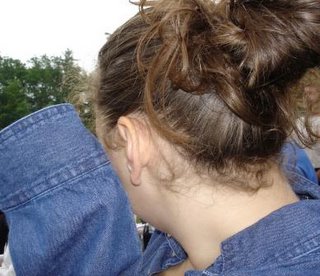
Happy birthday, Meg! And please let me take a picture of the front of your head sometime before you graduate from high school!
When she was little, she was a fashionista. She even helped her mother coordinate outfits right down to the accessories, coats, and make-up. One Christmas, in an effort to reel in out-of-control gift-giving, the family decided to draw names so only one person would buy for each kid. I got Megan. I think she was five years old that Christmas. The fun part about this method was that I got to spend my entire "kid budget" on one kid! It was an easy decision: I bought Megan a miniature wardrobe. She was little. Fred Meyer and Target had inexpensive clothes that were cute and colorful. It was a blast.
Ah, but that was 12 long years ago. For today is Megan's 17th birthday. A junior in high school, contacts replacing glasses, braces removed, a boyfriend, a job, and a driver's license (alternately in and out of her possession), a plan to become a high school social studies teacher. The girl who became my second-oldest niece and first goddaughter is growing up. (Can you hear the sniffing again? Pass me a tissue!) Her wardrobe now consists of demin and fleece, which is almost universally the teenager's uniform. She may be just the tiniest bit less helpful to her fashion-challenged Mom.
Happy birthday, Meg! And please let me take a picture of the front of your head sometime before you graduate from high school!
Tuesday, December 06, 2005
a question
Who were you before life took its toll?
Reading a book. Something I don't do often. Did it today because I was at jury selection. This question made me think. Imagine that. Reading a book that makes you think.
Reading a book. Something I don't do often. Did it today because I was at jury selection. This question made me think. Imagine that. Reading a book that makes you think.
Friday, December 02, 2005
chicken mushroom magic
I love traditions. Big ceremonious ones are very satisfying, like graduations, weddings, and school plays. But I relish little ones, like setting up Christmas lights on Thanksgiving evening every year. My family was chock full of traditions. The great thing was that we had a combination of the ones we carried forward from old family ways and new ones we made up as we went along. I wasn't around for the inception of our Saturday night supper, so I can't speak to its origins (I should ask my Mom).
Sitting down for dinner was the norm in our house. The dining room was used as a dining room, with its large oval table and seven chairs commandeering the space. No television or radio played. We talked with each other while we ate (although never with our mouths full). If the phone rang, one of us answered it to take a message, hung up, and went back to the table. What a radical concept.
My mother was incredibly adept at providing a tremendous variety of meals for us. Pot roasts, turkey dinners, stuffed pork chops, baked chicken, tacos, chow mein, veal parmesan, spinach omelette (one of my favorites), liver kapama (another favorite, and yes, it was liver!), spaghetti and meatballs (with a small portion of rigatoni made especially for me because I didn't like eating spaghetti), the list went on and on. She must have tried hundreds of new recipes over the years. There was one night every week, though, where there was no variety. On Saturday, supper was always the same -- baked beans, sauerkraut, and hot dogs.
Although this may seem like it was an "easy" meal compared with some of the others, the truth is, she started preparation for this meal on Friday. Picking through the beans to remove stones, rinsing the beans, and soaking them overnight. First thing Saturday morning, she started preparing a brew of wonderous ingredients into which the freshly softened beans would go. I remember that the recipe included molasses. Mmmmm. Boiled and simmered on the stove before being plunged into the oven for hours and hours of slow baking.
Mom even added her own flair to the sauerkraut by cooking it with sour cream. Until I went to college, I never knew that people ate it without sour cream. The house always smelled delicious on Saturdays. I loved that meal. Strangely, I never asked her for the recipe. Perhaps because making baked beans for one person would seem so strange. I might have asked for it when Ted came into my life and I could cook for two. But he doesn't like beans. He has happily learned to love the sauer/sour combination, though.
Anyway, we decided earlier this year that it was time to have our own supper tradition. We decided on a dish that is super easy to make, that gloats in its comfort-foody-ness, and has precious little nutritional value. That dish is Chicken Mushroom Magic.
This is not Julia Child. This is not even Rachael Ray. This is two boneless, skinless chicken breasts (we do take them out of the freezer the day before and thaw them in the fridge) and canned Campbell's Cream of Mushroom soup together in a Pyrex baking dish in the oven at 325F for 40 minutes. That's it. Nothing else. No oil. No spices. No milk.
About 10 minutes before the Magic is done, we whip up some Idahoan instant mashed potatoes (water, milk, margarine in the microwave for five minutes then potato flakes blended in and fluffed with a fork). Sometimes, I'll have peas (LaSeur canned sweet baby peas, to be exact). Ted doesn't like peas, so sometimes, he'll have corn. To drink, it's skim milk for me and diet cola for Ted. Other than that, there's no variation. It doesn't get much easier. It's very indulgent and yummy. It's our Friday supper tradition. Tonight was no exception.
Funny how embracing a new tradition can make a person long for an old one. Maybe I'll ask my Mom for that baked bean recipe this weekend.
shhhhhh
 it's snowing here. just the teensiest bit. it'll never stick, 41 degrees. the wind intermingles flakes and leaves and flings them all about recklessly. now it's harder to see the white bits from the brown bits. bound to end at any second. meteorologists forecast nothing about it. distant patches of blue reveal hints of sunshine. there will be no evidence remaining of this precipitation. it's my little secret. winter is here.
where were you 6,576 days ago?
I was a senior in college. It was very cold that day. I attended classes, deejayed a shift of alternative music at WSJB-FM (ah, the joy of college radio), had a 2-hour shift at my work study job, watched Oprah. In the evening, as part of a music appreciation class, I "rented" one of the College's 15-passenger vans and took about ten other students to the symphony. Most of the participant were underclassmen. I don't know why I remember that detail.
Anyway, it was snowing by the time we left campus for Portland. The symphony was wonderful, although they did one piece by Shostakovitz that I found nearly impossible to listen to. The dissonance was terrible! If his intent in composing the piece was to make the listener feel on edge, he succeeded. Later, I wrote an article for the school newspaper called "Cacophony at the Symphony." I was a clever one, I was.
When the show was over, we headed out to the van, now covered in several inches of snow. I drove very slowly back to campus, dropped everyone off at their respective residence halls, returned the van, and walked back to my townhouse. When I got to my room, there was a message on the door for me to call my parents.
Knowing that my sister-in-law had gone into labor the day before (poor thing), I had a hunch what this message was all about. The phone in our townhouse was being used (one phone for 24 girls), so I ran to the next townhouse over. It was the boys' townhouse, and they rarely used their phone. I called home and received the news that my new niece had arrived! Her name was Caitlin Elizabeth.
I've become one of those middle-aged ladies who always says things like, "my, where has the time gone?" and "I can't believe it's been 18 years." You know what? I don't care! I am middle-aged. And I really don't believe it's been 18 years.
Happy birthday, Cait! You've brought joy and laughter and light into my life ever since that cold snowy night in 1987.
Thursday, December 01, 2005
forgiving clock
There's a psychologist somewhere in the world who would tell me that forgiveness will set me free from my ongoing dreams. If I can bring myself to forgive Clock for all that was said and done, then I'll have resolution and the dreams will stop, right? Closure will make it happen. Right?
Phooey.
It's easy for me to forgive Clock. I know that there were challenges in Clock's life that contributed to the behavior, and I understand that the behavior was an adaptation designed to deflect pain and criticism to others so as not to feel it personally. There. Some of my own armchair psychology.
However, there are two important factors, even taking that knowledge into consideration. [1] The presence of tribulations in one's life neither fates a person to unhappiness nor gives blanket permission for meanness. And [2] I have no reason to believe that Clock thinks there's anything to be forgiven for. Absolution may well mean nothing to the recipient, so it means nothing to me.
I find myself at the same conclusion as this morning's entry -- resigned to the occasional dream. It could be worse.
billy ocean meant it in a good way
Many years ago, I removed myself from the life of someone with whom I'd been friends for a long time. I'll call this person Clock. It was a decision that was long in coming, but easily made when Clock delivered one last insult. There had been many before, but this time, I had reached the point in my life where I realized, by definition, friends were people who didn't hurt me. That life was too precious to spend time with people who didn't appreciate me.
And although the decision was made quickly after that particular incident, it was not an easy decision. I was young enough that my fear of confrontation was still partly intact, so instead of having a heart-to-heart conversation with Clock, I simply cut off contact. I had actually tried to have just such a discussion many years earlier after another especially egregious act, but Clock was able to talk me out of it. I was much younger then.
It's one thing to lose touch with friends: that has happened more times than I can count. It's another altogether to intentionally, unilaterally shut it down. For several years, I thought about it often. I didn't question my decision. Still don't. I think I was just coming to terms with the manner in which I handled the situation. That was compounded by the fact that Clock continued to attempt contact with me on a regular basis. Those attempts have dwindled. My response has been consistent -- no response.
Over the years, Clock has slowed down communications, and I don't think about it as often as I once did. But there's one lingering after-effect of this process. Clock pops up in my dreams every once in a while. Although this phenomenon has also slowly abated, it has not completely disappeared. Clock moved in with us and quickly set up house in last night's dream, moving furniture, dispensing of our personal items, scrubbing every corner with bleach, and painting everything -- including the appliances -- white.
What was that I said about all the details in a dream being meaningful? Seriously, my interpretation is straightforward. Despite the decisive nature of my relationship-ending method, the situation is still unresolved. I wonder at what moment in my future will resolution be attained? Perhaps it never will be. Until then, I continue to live my life conscientiously and happily, knowing that every once in a while, I may have some dream interpretation to do.
Subscribe to:
Posts (Atom)