RIP Nodar Kumaritashvili

 Last weekend on the drive to Mom's house, my attention was captured by what appeared to be a broken heart fashioned from wood and mounted on a tree by the side of the road. At the time, I had a full 'to do' list, and wanted to stay on track. Onward I drove.
 Upon closer inspection, I discovered messages.
 I missed a day. In my defense, it was the day I went to the doctor and was diagnosed with a viral infection, a bacterial infection, and a fever. In all, I worked about 4 hours this week -- and I'm still not well. At least I have an understanding of what's going on and medication to treat it.
 Here are some things that I've thought about in the past few days, any of which I could write up in detail were I capable of allowing it to stand apart from the pack. Alas, they all mix together in a confusing and perplexing manner.
 Shall tomorrow's entries all be titled "Sunday Stuff?" Shall I blog at all tomorrow? Only time will tell.
 Speaking of today's date, it's also my brother's 50th birthday and Veterans' Day. When I was growing up, the running joke in our family was that Gerry thought school was closed because it was his birthday. He's still climbing ice walls, camping in the desert, geocaching, and eagerly seeking out new things to learn. He's the youngest half-centenarian I know. Happy birthday, Gere!
 The New York Times had a feature today where they showcased the designs of several artists who each proposed a new way honor veterans. Most of them were interesting. There was a large window in the shape of the United States. A "USA OK" t-shirt. The official American uniform (Levi's jeans, white t-shirt, Rayban sunglasses, and optional Chuck Taylor sneakers).
 One of my favorite television shows (House) recently centered an episode on the mysterious health travails of George Hagel -- a 600 pound man. Upon watching the show, I am extremely satisfied by it. That happens so rarely when it comes to fat in entertainment that I feel it warrants mention.
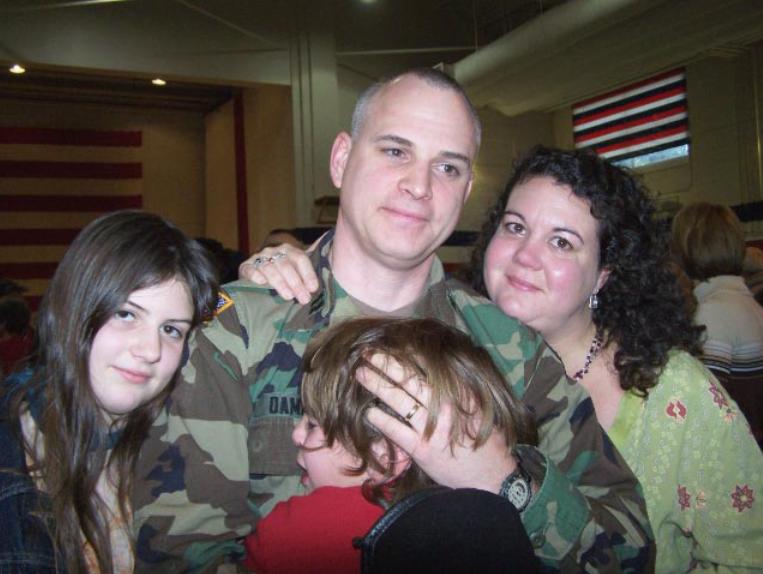 This is the Damon family. My friend, Hildi (right) married the sweet and dutiful brainiac, Pat, 19 years ago. Their daughter, Mikayla is 14, and their son, Jan-Christian is 12. This picture was taken the day that Pat was deployed to Afghanistan with the Army National Guard in January. Hildi'd sent me this picture along with five others, all of the kids being alternately goofy and pensive. As you might imagine, everyone was sad to see him go.

 Katelyn was a neighbor of Caitlin's family, already graduated from high school. She was hit head-on by a drunk driver. Katelyn loved kids and worked two jobs that allowed her to be around them, at a Babies 'R Us store and a mall carousel. She also excelled in art. She was 19 years old.

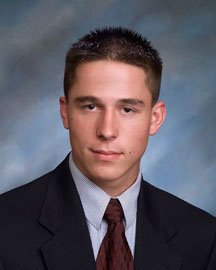
 Steve was riding in Carl's car. He suffered massive injuries and underwent two surgeries before dying three days later. Steve was an avid wrestler and Eagle Scout. He and his twin brother, Sam, built trails and bridges in a conservation area for hikers and snowshoers to use. His sister, Jess, is one of Caitlin's close friends. This is also his senior portrait. He was also 17 years old.
Macabre Reminder: The Corpse on Union Street
By DAN BARRY
NEW ORLEANS, Sept. 7 - In the downtown business district here, on a dry stretch of Union Street, past the Omni Bank automated teller machine, across from a parking garage offering "early bird" rates: a corpse. Its feet jut from a damp blue tarp. Its knees rise in rigor mortis.
Six National Guardsmen walked up to it on Tuesday afternoon and two blessed themselves with the sign of the cross. One soldier took a parting snapshot like some visiting conventioneer, and they walked away. New Orleans, September 2005.
Hours passed, the dusk of curfew crept, the body remained. A Louisiana state trooper around the corner knew all about it: murder victim, bludgeoned, one of several in that area. The police marked it with traffic cones maybe four days ago, he said, and then he joked that if you wanted to kill someone here, this was a good time.
Night came, then this morning, then noon, and another sun beat down on a dead son of the Crescent City.
That a corpse lies on Union Street may not shock; in the wake of last week's hurricane, there are surely hundreds, probably thousands. What is remarkable is that on a downtown street in a major American city, a corpse can decompose for days, like carrion, and that is acceptable.
Welcome to New Orleans in the post-apocalypse, half baked and half deluged: pestilent, eerie, unnaturally quiet.
Scraggly residents emerge from waterlogged wood to say strange things, and then return into the rot. Cars drive the wrong way on the Interstate and no one cares. Fires burn, dogs scavenge, and old signs from les bons temps have been replaced with hand-scrawled threats that looters will be shot dead.
The incomprehensible has become so routine here that it tends to lull you into acceptance. On Sunday, for example, several soldiers on Jefferson Highway had guns aimed at the heads of several prostrate men suspected of breaking into an electronics store.
A car pulled right up to this tense scene and the driver leaned out his window to ask a soldier a question: "Hey, how do you get to the interstate?"
Maybe the slow acquiescence to the ghastly here - not in Baghdad, not in Rwanda, here - is rooted in the intensive news coverage of the hurricane's aftermath: floating bodies and obliterated towns equal old news. Maybe the concerns of the living far outweigh the dignity of a corpse on Union Street. Or maybe the nation is numb with post-traumatic shock.
Wandering New Orleans this week, away from news conferences and search-and-rescue squads, has granted haunting glimpses of the past, present and future, with the rare comfort found in, say, the white sheet that flaps, not in surrender but as a vow, at the corner of Poydras Street and St. Charles Avenue.
"We Shall Survive," it says, as though wishing past the battalions of bulldozers that will one day come to knock down water-corrupted neighborhoods and rearrange the Louisiana mud for the infrastructure of an altogether different New Orleans.
Here, then, the New Orleans of today, where open fire hydrants gush the last thing needed on these streets; where one of the many gag-inducing smells - that of rancid meat - is better than MapQuest in pinpointing the presence of a market; and where images of irony beg to be noticed.
The Mardi Gras beads imbedded in mud by a soldier's boot print. The "take-away" signs outside restaurants taken away. The corner kiosk shouting the Aug. 28 headline of New Orleans's Times-Picayune: "Katrina Takes Aim."
Rush hour in downtown now means pickups carrying gun-carrying men in sunglasses, S.U.V.'s loaded with out-of-town reporters hungry for action, and the occasional tank. About the only ones commuting by bus are dull-eyed suspects shuffling two-by-two from the bus-and-train terminal, which is now a makeshift jail.
Maybe some of them had helped to kick in the portal to the Williams Super Market in the once-desirable Garden District. And who could blame them if all they wanted was food in those first desperate days? The interlopers took the water, beer, cigarettes and snack food. They did not take the wine or the New Orleans postcards.
On the other side of downtown across Canal Street in the French Quarter, the most raucous and most unreal of American avenues is now little more than an empty alley with balconies.
The absence of sweetly blown jazz, of someone cooing "ma chère," of men sporting convention nametags and emitting forced guffaws - the absence of us - assaults the senses more than any smell.
Past the famous Cafe du Monde, where a slight breeze twirls the overhead fans for no one, past the statue of Joan of Arc gleaming gold, a man emerges from nothing on Royal Street. He is asked, "Where's St. Bernard Avenue?"
"Where's the ice?" he asks in return, eyes narrowed in menace. "Where's the ice? St. Bernard's is that way, but where's the ice?"
In Bywater and the surrounding neighborhoods, the severely damaged streets bear the names of saints who could not protect them. Whatever nature spared, human nature stepped up to provide a kind of democracy in destruction.
At the Whitney National Bank on St. Claude Avenue, diamond-like bits of glass spill from the crushed door, offering a view of the complementary coffee table. A large woman named Phoebe Au - "Pronounced 'Awe,' " she says - materializes to report that men had smashed it in with a truck. She fades into the neighborhood's broken brick, and a thin woman named Toni Miller materializes to correct the record.
"They used sledgehammers," she said.
Farther down St. Claude Avenue, where tanks rumble past a smoldering building, the roads are cluttered with vandalized city buses. The city parked them on the riverbank for the hurricane, after which some hoods took them for fare-free joy rides through lawless streets, and then discarded them.
On Clouet Street, where a days-old fire continues to burn where a warehouse once stood, a man on a bicycle wheels up through the smoke to introduce himself as Strangebone. The nights without power or water have been tough, especially since the police took away the gun he was carrying - "They beat me and threatened to kill me," he says - but there are benefits to this new world.
"You're able to see the stars," he says. "It's wonderful."
Today, law enforcement troops began lending muscle to Mayor C. Ray Nagin's vow to evacuate by force any residents too attached to their pieces of the toxic metropolis. They searched the streets for the likes of Strangebone, and that woman whose name sounds like Awe.
Meanwhile, back downtown, the shadows of another evening crept like spilled black water over someone's corpse.